

How To Customize Windows 10 Start Menu For All Users
This browser is no longer supported.
Upgrade to Microsoft Edge to have advantage of the latest features, security updates, and technical support.
Customize Windows ten Start and taskbar with Grouping Policy
Applies to
- Windows x
Looking for consumer information? Run across Customize the First menu
In Windows 10 Pro, Enterprise, and Pedagogy, y'all tin can use a Group Policy Object (GPO) to deploy a customized Start and taskbar layout to users in a domain. No reimaging is required, and the layout can be updated simply by overwriting the .xml file that contains the layout. This enables yous to customize Start and taskbar layouts for different departments or organizations, with minimal management overhead.
This topic describes how to update Group Policy settings to display a customized Start and taskbar layout when the users sign in. By creating a domain-based GPO with these settings, you can deploy a customized Start and taskbar layout to users in a domain.
Warning
When a full Kickoff layout is applied with this method, the users cannot pivot, unpin, or uninstall apps from Commencement. Users can view and open up all apps in the All Apps view, merely they cannot pin any apps to Start. When a fractional Start layout is applied, the contents of the specified tile groups cannot exist inverse, but users can move those groups, and tin can also create and customize their own groups. When you use a taskbar layout, users will still be able to pin and unpin apps, and change the social club of pinned apps.
Before you lot begin: Customize and export Start layout
Operating system requirements
In Windows 10, version 1607, Start and taskbar layout command using Group Policy is supported in Windows 10 Enterprise and Windows 10 Education. In Windows x, version 1703, First and taskbar layout control using Group Policy is also supported in Windows 10 Pro.
The GPO tin can be configured from any reckoner on which the necessary ADMX and ADML files (StartMenu.admx and StartMenu.adml) for Windows ten are installed. In Group Policy, ADMX files are used to ascertain Registry-based policy settings in the Administrative Templates category. To find out how to create a central store for Authoritative Templates files, encounter article 929841, written for Windows Vista and still applicative in the Microsoft Noesis Base.
How Beginning layout control works
3 features enable Outset and taskbar layout command:
-
The Consign-StartLayout cmdlet in Windows PowerShell exports a clarification of the current Beginning layout in .xml file format.
Note
To import the layout of First to a mounted Windows image, apply the Import-StartLayout cmdlet.
-
Y'all tin can modify the Start .xml file to include
<CustomTaskbarLayoutCollection>or create an .xml file merely for the taskbar configuration. -
In Grouping Policy, you use the Showtime Layout settings for the Start Menu and Taskbar authoritative template to fix a Start and taskbar layout from an .xml file when the policy is applied. The Grouping Policy object doesn't support an empty tile layout, and so the default tile layout for Windows is loaded in that case.
Utilise Group Policy to apply a customized Start layout in a domain
To apply the Start and taskbar layout to users in a domain, use the Group Policy Management Console (GPMC) to configure a domain-based Grouping Policy Object (GPO) that sets Start Layout policy settings in the Start Menu and Taskbar administrative template for users in a domain.
The GPO applies the Showtime and taskbar layout at the next user sign-in. Each time the user signs in, the timestamp of the .xml file with the Showtime and taskbar layout is checked and if a newer version of the file is available, the settings in the latest version of the file are applied.
The GPO can be configured from any figurer on which the necessary ADMX and ADML files (StartMenu.admx and StartMenu.adml) for Windows ten are installed.
The .xml file with the Start and taskbar layout must be located on shared network storage that is available to the users' computers when they sign in and the users must have Read-only access to the file. If the file is not available when the first user signs in, Showtime and the taskbar are not customized during the session, merely the user volition be prevented from making changes to Start. On subsequent sign-ins, if the file is available at sign-in, the layout it contains will be applied to the user'southward Offset and taskbar.
For data virtually deploying GPOs in a domain, encounter Working with Grouping Policy Objects.
Use Group Policy to apply a customized Start layout on the local computer
You tin can employ the Local Group Policy Editor to provide a customized Beginning and taskbar layout for any user who signs in on the local computer. To display the customized Start and taskbar layout for any user who signs in, configure Start Layout policy settings for the Start Bill of fare and Taskbar administrative template. You tin can employ the Start Menu and Taskbar authoritative template in User Configuration or Calculator Configuration.
Notation
This procedure applies the policy settings on the local estimator only. For information about deploying the Commencement and taskbar layout to users in a domain, run across Use Group Policy to deploy a customized Start layout in a domain.
This procedure creates a Local Grouping Policy that applies to all users on the calculator. To configure Local Group Policy that applies to a specific user or group on the computer, encounter Step-by-Footstep Guide to Managing Multiple Local Grouping Policy Objects. The guide was written for Windows Vista and the procedures still use to Windows 10.
This procedure adds the customized Start and taskbar layout to the user configuration, which overrides whatever Start layout settings in the local computer configuration when a user signs in on the computer.
To configure Commencement Layout policy settings in Local Group Policy Editor
-
On the examination computer, press the Windows key, type gpedit, and and then select Edit group policy (Control panel).
-
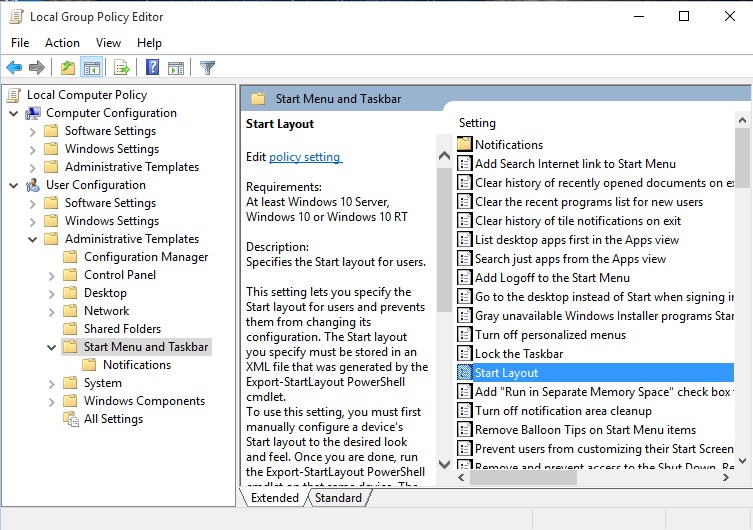
Get to User Configuration or Estimator Configuration > Authoritative Templates >Start Card and Taskbar.
-
Right-click First Layout in the correct pane, and click Edit.
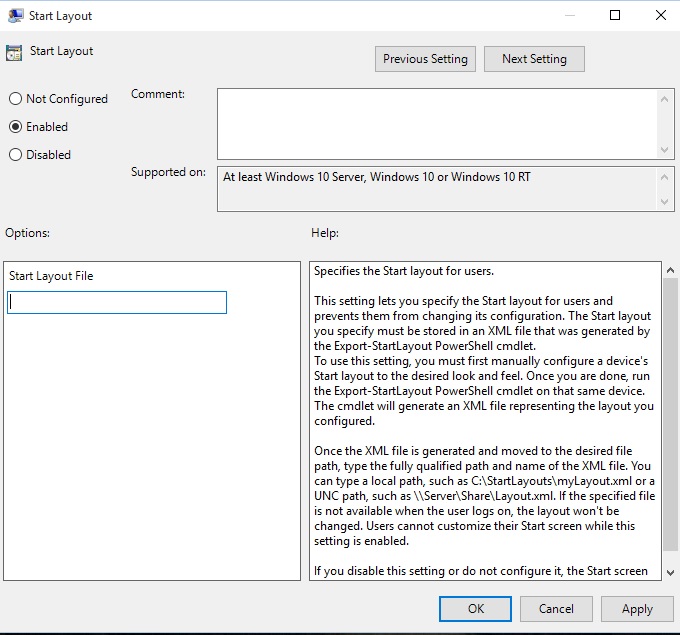
This opens the Start Layout policy settings.
-
Enter the following settings, and then click OK:
-
Select Enabled.
-
Under Options, specify the path to the .xml file that contains the Offset and taskbar layout. For example, type C:\Users\Test01\StartScreenMarketing.xml.
-
Optionally, enter a comment to identify the Start and taskbar layout.
Important
If you disable Start Layout policy settings that accept been in effect and so re-enable the policy, users will not be able to make changes to Start, nevertheless the layout in the .xml file volition not be reapplied unless the file has been updated. In Windows PowerShell, you can update the timestamp on a file by running the post-obit control:
(ls <path>).LastWriteTime = Get-Date -
Update a customized Start layout
Afterwards you use Grouping Policy to apply a customized Start and taskbar layout on a calculator or in a domain, you can update the layout simply by replacing the .xml file that is specified in the Start Layout policy settings with a file with a newer timestamp.
- Manage Windows 10 Commencement and taskbar layout
- Configure Windows 10 taskbar
- Customize and export Start layout
- Add epitome for secondary tiles
- Start layout XML for desktop editions of Windows 10 (reference)
- Customize Windows 10 Commencement and taskbar with provisioning packages
- Customize Windows 10 Start and taskbar with mobile device management (MDM)
- Changes to Outset policies in Windows ten
Source: https://docs.microsoft.com/en-us/windows/configuration/customize-windows-10-start-screens-by-using-group-policy
Posted by: pradomothre.blogspot.com
0 Response to "How To Customize Windows 10 Start Menu For All Users"
Post a Comment